Pearson Edexcel · GCSE · History
Course version: 1HI0 · Version from Sept 2016
C1000–c1500: Crime and punishment in medieval England - 1 Nature and…
Full specification wording
Option 10: c1000–c1500: Crime and punishment in medieval England - 1 Nature and changing definitions of criminal activity: Crimes against the person, property and authority, including poaching as an example of ‘social’ crime.
In medieval England, crimes were categorised into three main types: against the person (such as murder or assault), against property (such as theft or arson), and against authority (such as…
Checked against the Pearson Edexcel 1HI0 specification (opens in a new tab) on .
- Point 1 of 2
- 4 key terms
Study notes
From the checked teaching notes for this specification point.
The idea
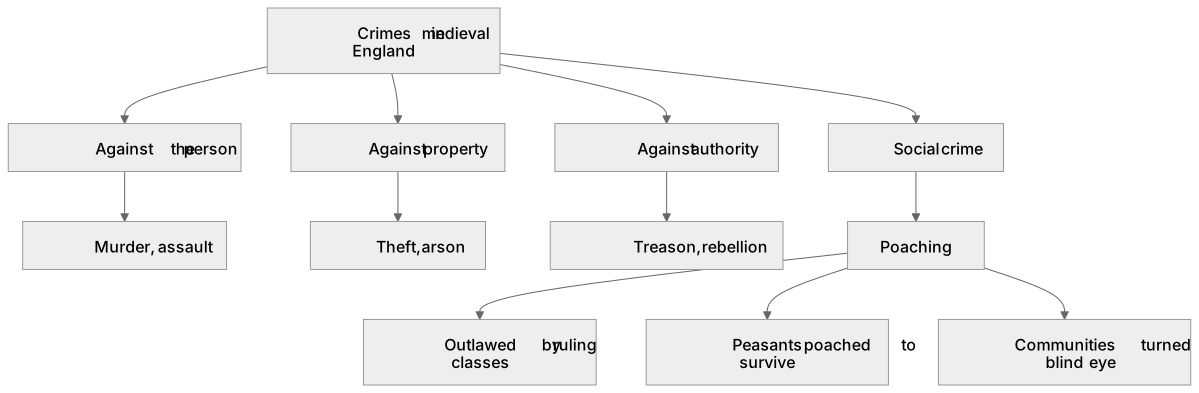
In medieval England, crimes were categorised into three main types: against the person (such as murder or assault), against property (such as theft or arson), and against authority (such as treason or rebellion). A key concept is the 'social crime', an illegal act that many in the community did not view as morally wrong. Poaching is the prime example of a social crime during this period. While the ruling classes strictly outlawed hunting on private or royal land to protect their privileges, ordinary peasants often poached rabbits or deer to supplement their meagre diets and survive. Consequently, local communities frequently turned a blind eye to poaching, making it difficult for authorities to enforce the law effectively.
What earns the marks
- Define crimes against the person with examples like murder and assault.
- Define crimes against property with examples like theft and arson.
- Define crimes against authority with examples like treason and rebellion.
- Explain the concept of a 'social crime' as an act deemed illegal by authorities but acceptable by the local community.
- Use poaching as the primary example of a social crime, explaining why peasants poached and why communities protected them.
Common mistakes and how to put them right
Confusing crimes against property with crimes against authority.
Put it right: Ensure theft is categorised as a property crime, while treason is a crime against authority.
Stating that poaching was universally condemned.
Put it right: Explain that poaching was a 'social crime' widely accepted by the peasant community but punished by the authorities.
Failing to provide specific examples for each category of crime.
Put it right: Link the broad category (e.g., crime against the person) to a specific medieval example (e.g., murder).
Exam tips
- When asked about the nature of medieval crime, explicitly use the categories: person, property, and authority.
- Use poaching to illustrate the tension between the laws made by the rich and the survival needs of the poor.
- Be prepared to explain why social crimes were particularly difficult for medieval authorities to police.
Try the lesson
The start of the Option 10: c1000–c1500: Crime and punishment in medieval England - 1 Nature and changing definitions of criminal activity: Crimes against the person, property and authority, including poaching as an example of ‘social’ crime. lesson, made from checked teaching notes for this specification point.
Have a go first
In medieval England, which of the following is an example of a crime against the person?
Listen
In medieval England, crimes were categorised into three main types: against the person (such as murder or assault), against property (such as theft or arson), and against authority (such as treason or rebellion). A key concept is the 'social crime', an illegal act that many in the community did not view as morally wrong. Poaching is the prime example of a social crime during this period. While the ruling classes strictly outlawed hunting on private or royal land to protect their privileges, ordinary peasants often poached rabbits or deer to supplement their meagre diets and survive. Consequently, local communities frequently turned a blind eye to poaching, making it difficult for authorities to enforce the law effectively. A strong answer earns marks for these points. Define crimes against the person with examples like murder and assault. Define crimes against property with examples like theft and arson. Define crimes against authority with examples like treason and rebellion. Explain the concept of a 'social crime' as an act deemed illegal by authorities but acceptable by the local community. A common slip: Confusing crimes against property with crimes against authority. Instead, Ensure theft is categorised as a property crime, while treason is a crime against authority. Exam tip: When asked about the nature of medieval crime, explicitly use the categories: person, property, and authority.
See it
Watch it explained
What is the one idea the video explains? Say it in a sentence.
Read the described scene instead
In medieval England, crimes were grouped into three main types. Crimes against the person included murder and assault. Crimes against property included theft and arson. Crimes against authority included treason and rebellion. These categories help historians describe the nature of criminal activity between about one thousand and fifteen hundred. Keep the categories distinct. Murder and assault are crimes against the person. Theft and arson are crimes against property. Treason and rebellion are crimes against authority. A common mistake is to confuse property crimes with authority crimes, so remember that theft belongs with property, while treason belongs with authority. A key concept is the social crime. This is an illegal act that many in the community did not view as morally wrong. Poaching is the prime example in this period. The ruling classes outlawed hunting on private or royal land to protect their privileges. Ordinary peasants often poached rabbits or deer to supplement meagre diets and survive, so local communities frequently turned a blind eye. Do not state that poaching was universally condemned. It was a social crime, widely accepted by the peasant community but punished by the authorities. Also avoid failing to give specific examples for each category. Always link a broad category to a medieval example, such as murder for a crime against the person. For medieval crime, use the categories of person, property and authority. Use poaching to show tension between laws made by the rich and survival needs of the poor. Social crimes were difficult for authorities to police because local communities often protected the offenders or ignored the offence. Pause and think: why would a community's attitude make enforcement harder?
Key words
Say what each word means before you turn the card.
Social crime
Try answering aloud or in your head before turning the card.
Crimes against the person
Try answering aloud or in your head before turning the card.
Crimes against property
Try answering aloud or in your head before turning the card.
Crimes against authority
Try answering aloud or in your head before turning the card.
See every definition
- Social crime
- An illegal act that many in the community did not view as morally wrong, with poaching as the prime example.
- Crimes against the person
- A category of medieval crime including murder and assault.
- Crimes against property
- A category of medieval crime including theft and arson.
- Crimes against authority
- A category of medieval crime including treason and rebellion.
Label the diagram
Some boxes have lost their names. Pick the right name for each number.
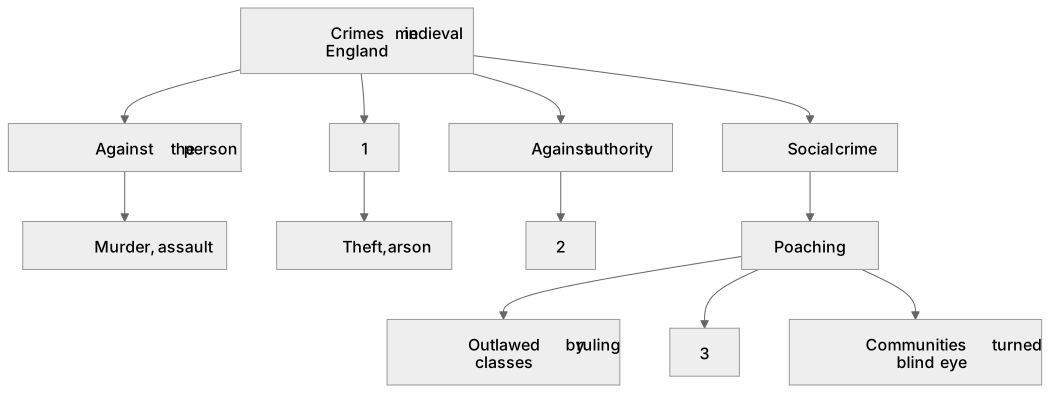
1Box 1
2Box 2
3Box 3
There is more to this lesson
The full lesson goes on to check your understanding and help you earn the marks. Create a free account to carry on, with your progress saved.
A week of Premium from your first lesson · Then the free plan continues · No card, no charge
Test your understanding of Option 10: c1000–c1500: Crime and punishment in medieval England - 1 Nature and changing definitions of criminal activity: Crimes against the person, property and authority, including poaching as an example of ‘social’ crime.
Active recall beats re-reading. Take an instant quiz now to test what you’ve learned and lock it into long-term memory.
A week of Premium from your first lesson · Then the free plan continues · No card, no charge